
APPRAISAL CLASSES
Live Instruction Appraisal Classes to
become a qualified Appraiser Trainee
CLASS SCHEDULES FOR REAL ESTATE APPRAISERS
Evenings Only
TUE 6 PM – 10 PM
THU 6 PM – 10 PM
SAT 6 PM – 10 PM
To get copy of General Information Pages
Just Click down on the link below here:
APPRAISAL CLASSES – Noble Fields.pdf
NOBLE FIELDS SCHOOL of REAL ESTATE
6121 Mission Street, Daly City, CA 94014
Call (415) 608-1388
noblefields6@gmail.com
DRE Sponsor Number: S0170
Basic Education Requirements
To all our applicants, please always check with the Bureau of Real Estate Appraisers (BREA) for new education requirements.
- Appraiser Trainees Applicants, effective on January 1, 2015, prior to obtaining a Trainee license and
prior to experience hours: Appraiser Qualifica (AQB) Supervisory Appraiser/Trainee Appraiser Course – 4 Hours - Starting Appraisal Applicant, effective on January 1, 2023, please take the Cultural Competency course – 1 Hour
- Appraisal License Renewals, effective on January 1, 2023, please take the Cultural Competency course – 1 Hour
- Starting Appraisal Applicants, effective on January 1, 2026, please take the Appraiser Qualifications
Board (AQB) Approved new course – Valuation Bias and Fair Housing Laws & Regulations course – 8 Hours - Appraisal License Renewals, effective on January 1, 2026, please take the Appraiser Qualifications
Board (AQB) Approved new course – Valuation Bias and Fair Housing Laws & Regulations course – 7 Hours
and all subsequent renewal cycles – Valuation Bias and Fair Housing Laws & Regulations course – 4 Hours
BECOME AN APPRAISER TRAINEE
SCOPE OF PRACTICE
Any property which the supervising appraiser is permitted to appraise under direct,
personal, and diligent supervision of supervisory appraiser(s).
REQUIREMENTS
Age
- 18 years of age or older
Qualifying Education – 83 Hours
- Basic Appraisal Principles – 30 Hours
- Basic Appraisal Procedures – 30 Hours
- National USPAP Course (or its equivalent) – 15 Hours
- Valuation Bias and Fair Housing Laws
and Regulations – 8 Hours
Additional California Education Requirements – 9 Hours
- AQB/BREA approved Supervisor/Trainee Appraiser course – 4 Hours
- AQB/BREA approved Cultural Competency course – 1 Hour
- BREA approved Laws and Regulations course – 4 Hours
All qualifying and additional California education must be completed within
the five (5) year period immediately preceding the date of application for
a Trainee Appraiser credential.
Experience
- No experience is required as a prerequisite. Applicants must work under a Supervisor
Appraiser (Certified Credentials) meeting the Supervisory Appraiser Requirements to
gain experience.
Background
- Applicants are required to complete a fingerprint background check as part of
the application review process. After BREA receives a complete application
package, California-resident applicants will be provided with the required Live
Scan form and instructions for submitting electronic fingerprints through the
California Department of Justice. - Applicants residing outside California must submit two fingerprint cards
FD-258 through an authorized agency in their state of residence. - A list of authorized Live Scan locations can be found on the California DOJ
website. Applicants are responsible for paying the required Live Scan fee at the
time of fingerprinting.
FILE YOUR APPLICATION
License Application
-
- Applicants must submit an initial application REA 3001 form.
- Applicants must use the REA 3002 form to report on the basic education courses.
Initial Trainee Application Fee
-
- A total of $930.00 non-refundable fee must be submitted along with the
application. Dishonored checks will result in an extra $25 fee. Applicants must pay
the application fee via check or money order made payable to “the Bureau.” - The check should include the applicant’s full name and the type of fee being
paid (e.g. Initial Trainee Application fee).- Cash payments are NOT accepted for any type of licensing fee.
- A total of $930.00 non-refundable fee must be submitted along with the
Application Status
-
- Applicants may track the status of their applications using the Application Status tracker.
UPGRADE: TRAINEE TO A LICENSED RESIDENTIAL APPRAISER
SCOPE OF PRACTICE FOR LICENSED RESIDENTIAL
Refer to 12 C.F.R. § 323.3 (Subchapter B, Chapter III, Title 12) – as currently in effect – and
to the Appraiser Qualifications Board (AQB) Criteria in force at the time of practice.
REQUIREMENTS
Age
- 18 years of age or older
Qualifying Education – 158 Hours
Appraisers holding a valid Trainee appraiser credential may satisfy the
educational requirements for the licensed residential credential by successfully
completing the following additional educational hours:
- Residential Market Analysis and Highest and Best Use – 15 Hours
- Residential Appraiser Site Valuation and Cost Approach – 15 Hours
- Residential Sales Comparison and Income Approaches – 30 Hours
- Residential Report Writing and Case Studies – 15 Hours
Total – 75 Hours
- If the applicant with an active license has not completed 8-hour Valuation Bias
and Fair Housing Laws and Regulations course, then they must complete it during
their upgrade application.
Additional California Education Requirements for Licensed Residential Applicants
- AQB/BREA approved Elimination of Bias course – 2 Hours
- AQB/BREA approved Cultural Competency course – 1 Hour
- BREA approved Laws and Regulations course – 4 Hours
- AQB/BREA approved National USPAP Update course – 7 Hours
Experience
- The residential applicants shall have a minimum of 1,000 hours of real property
appraisal experience obtained cumulatively over a period of not less than six (6)
months. - Both the Supervisory Appraiser and the residential applicants must have
completed the Supervisor/Trainee Appraiser course prior to gaining experience
in order for the work experience hours to be valid and count towards their credit. - As alternative pathways, the experience gained through AQB approved Licensed
Residential PAREA program or AQB and/or BREA approved Licensed Residential
Practicum program shall be accepted for 100% of the experience requirement.
FILE YOUR APPLICATION
License Application
-
- Applicants must submit an upgrade application REA 3023 form.
- Applicants must use the REA 3002 form to report on the basic education courses.
- The applicants must submit a log of appraisal experience using REA 3004 form.
- The applicants must provide appraisal work samples selected by BREA later in the
process.
Upgrade Licensed Residential Application Fee
-
- A total of $955.00 non-refundable fee must be submitted along with the
application. Dishonored checks will result in an extra $25 fee. Applicants must pay
the application fee via check or money order made payable to “the Bureau.” - The check should include the applicant’s full name and the type of fee being
paid (e.g. Upgrade to Licensed Residential Application fee).- Cash payments are NOT accepted for any type of licensing fee.
- A total of $955.00 non-refundable fee must be submitted along with the
National Uniform Licensing and Certification Examination
-
- Upon approval of their applications, the applicants will receive an eligibility letter from
BREA with instructions to schedule the examination. - Applicants are allowed five attempts to pass the examination within one year
from the date the Bureau issues the eligibility letter. If the application expires, the
applicant must submit a new application and pay all applicable fees. - Examination results are only accepted when presented in the official score report
issued by the examination administrator. - Applicants shall submit Application for License REA 3008 form after they pass the
examination.
- Upon approval of their applications, the applicants will receive an eligibility letter from
Application Status
-
- Applicants may track the status of their applications using the Application Status tracker.
Continuing Education Requirements for Appraisers
Two-year Renewal Cycle:
A total of fourteen (14) Hours.
Then eleven (11) Hours thereafter.
The two-year cycle continuing education should include:
- National USPAP Continuing Education course – 7 Hours
- Valuation Bias and Fair Housing Laws and Regulations course for the first time – 7 Hours
- Second Valuation Bias and Fair Housing Laws and Regulations course thereafter – 4 Hours
Four-year Renewal Cycle:
A total of fifty-six (56) Hours.
The four-year cycle continuing education should include:
- The second National USPAP Continuing Education Course – 7 Hours
- Completed within the most recent two-year period.
- This course must be newly completed since the last USPAP course submission.
- The second Valuation Bias and Fair Housing Laws and Regulations Course – 4 Hours
- Completed within the most recent two-year period.
- California Laws and Regulations course – 4 Hours
- Cultural Competency course – 1 Hour
- Elimination of Bias course – 2 Hours
- Valuation Bias and Fair Housing Laws and Regulations supersedes this course – 4 Hours
Work on getting 150 Hours of In-Person Live-Instruction from Noble Fields School of Real Estate
Are you ready for a career change? Sign up for our Appraisal Trainee Package today and start your journey to becoming a certified appraiser!
This appraisal course package has the minimum needed to start your valuable appraiser training.
Disclaimer: Any course work taken more than 5 years before the application date is not acceptable.
These General Information Pages are to be read by the participant prior to registration/enrollment.
Disclaimer: Selecting Order Here menus acknowledges you read and understood the General Information Pages.
Appraiser Trainee Starter Package
BREA Approval Numbers:
(08469001, 15CP469203001, 22CP469203003,
09469003, 21CP469203002, 10469004)
83 Hours –$699

In-Person Live-Instruction Courses

Appraisal Classes for Trainees and Residential License Applicants
In-Person Live-Instruction Class Schedule:
10-2 pm or 6-10 pm
Tuesday, Thursday, and Saturday
Join our appraiser classes to become a certified real estate appraiser in CA. Start your career today!
These General Information Pages are to be read by the participant prior to registration/enrollment.
Disclaimer: Selecting Order Here menus acknowledges you read and understood the General Information Pages.
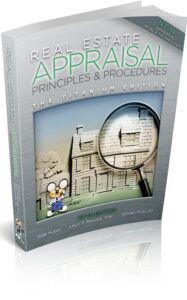
Real Estate Appraisal Principles and Procedures
BREA Approval Number:
(15CP469203001)
60 Hours – $299
Target Audience
Prerequisite qualifying education required for all initial Appraiser Trainee applicants and foundational for all levels of California real property appraiser licensing and certification.
Course Overview
This comprehensive 60-hour course combines foundational valuation theory with day-to-day appraisal methodology. Students explore basic appraisal principles—including legal descriptions, property rights, economic forces, and land use concepts—and master practical appraisal procedures, such as defining the problem, scope of work determination, data collection, paired sales analysis, and final value reconciliation.
Core Learning Objectives & Topics Covered
- Real Property Concepts & Legal Foundations:
- Distinguishing real estate (physical land and appurtenances) from real property (the bundle of legal rights).
- Land descriptions: Metes and bounds, rectangular (government) survey system, and recorded lot and block subdivision plats.
- Forms of ownership, encumbrances, easements, and police powers (zoning, building codes, taxation, and eminent domain).
- Forces & Economic Principles Influencing Value:
- Four Value Influences (PEGS): Physical/environmental, Economic, Governmental, and Social forces.
- Core Economic Principles: Anticipation, Balance, Change, Competition, Conformity, Contribution, Highest and Best Use, Progression and Regression, and Substitution.
- The 7-Step Appraisal Process (Valuation Procedure):
-
- Definition of the Problem: Identifying client and intended users, intended use, type and definition of value, effective valuation date, subject characteristics, and extraordinary assumptions/limiting conditions.
- Scope of Work Determination: Outlining the extent of research and analysis necessary to produce credible assignment results.
- Data Collection & Property Description: Gathering general market data (regional/neighborhood trends) and specific property data (physical measurements, condition, deed records).
- Data Analysis: Market analysis (demand/supply, absorption) and Highest and Best Use analysis (financially feasible, physically possible, legally permissible, and maximally productive).
- Site Valuation: Developing land value using sales comparison, extraction, or allocation.
- Application of the Three Approaches: Developing the Sales Comparison, Cost, and Income approaches where applicable.
- Reconciliation & Final Value Opinion: Evaluating the quality and quantity of data across approaches to reach a single defensible value conclusion and communicating the appraisal report under USPAP Standards.
Practical Application
Example 1: Applying Economic Principles (Progression vs. Regression)
Scenario: A modest 1,200 sq. ft. home ($500,000 neighborhood median) is situated in a tract where the average home size is 2,800 sq. ft. ($850,000 neighborhood median). Conversely, an over-improved 4,500 sq. ft. custom home is located in that same modest $500,000 tract.
-
Principle of Progression: The smaller 1,200 sq. ft. home benefits from the higher quality and value of surrounding properties; its value is pulled upward toward the higher-end neighborhood standard.
-
Principle of Regression: The over-improved 4,500 sq. ft. home is dragged downward by the surrounding modest properties; the market will not pay full construction cost for an over-improvement that lacks conformity with its neighborhood.
Example 2: Scope of Work & Problem Identification
Scenario: An appraiser is engaged to appraise a single-family home. During the physical inspection, the appraiser discovers that the rear detached garage has been converted into an unpermitted secondary living unit with a kitchen and full bathroom.
-
Step 1 (Problem Identification): Identify the legal zoning status and market acceptability of the unpermitted conversion.
-
Step 2 (Scope of Work Adaptation): Contact the municipal planning department to determine zoning compliance (legal, legal non-conforming, or illegal).
-
Step 3 (Valuation Action): If illegal and non-permitted, the appraiser cannot treat the structure as permitted living area without an explicit Extraordinary Assumption or condition requirement. The appraiser must either value the conversion based on contributory storage utility or deduct the estimated cost to cure (reconvert back to a garage), clearly disclosing all limiting conditions in the report.
Critical Issues: Fundamental Principles & Procedure Pitfalls
1. Confusing “Cost” with “Value”: Cost refers to the historical or current expenditure required to create or reproduce an improvement (materials, labor, financing). Value is the monetary relationship between buyers and sellers in the marketplace. A luxury improvement costing $50,000 may contribute little or nothing to overall property value if the local market does not demand it (Principle of Contribution).
2. Ignoring Scope of Work Flexibility: Under USPAP, the Scope of Work is not a static one-size-fits-all checklist; it must be continually re-evaluated as new information (such as deferred maintenance, non-conforming zoning, or unpermitted additions) is discovered during the assignment.
3. Omitting the Highest and Best Use Conclusion: Valuing an improved property without first analyzing whether the existing structure represents the Highest and Best Use “as improved” vs. “as though vacant” can invalidate the entire appraisal analysis.
CA LAWS and REGULATIONS for APPRAISERS
BREA Approval Number:
(22CP469203003)
4 hours – $199
Mandatory Course
Mandated by the State of California Bureau of Real Estate Appraisers (BREA) under California Code of Regulations (CCR) Title 10, Chapter 6.5, for all initial Trainee applicants and active licensees during each four-year continuing education cycle.
Course Overview
This course delivers essential updates and legal analysis on the federal and California statutory frameworks governing real estate appraisal. Licensees and trainees review the Real Estate Appraisers’ Licensing and Certification Law, state enforcement procedures, mandatory recordkeeping, supervisory responsibilities, and ongoing statutory changes to ensure full regulatory compliance and risk mitigation.
Core Learning Objectives & Topics Covered
- California Statutory & Regulatory Framework:
- The California Real Estate Appraisers’ Licensing and Certification Law (Business and Professions Code § 11300 et seq.).
- California Code of Regulations (CCR), Title 10, Chapter 6.5: Administrative procedures, licensing classifications, scope of practice, and disciplinary guidelines.
- Bureau of Real Estate Appraisers (BREA) Oversight:
- BREA complaint intake, formal investigations, citations, administrative fines, and contested hearing procedures under the California Administrative Procedure Act.
- Mandatory reporting requirements: Notifying BREA within 30 days of criminal convictions, felony charges, civil judgments alleging fraud or misrepresentation, or disciplinary actions by other regulatory agencies.
- Federal Mandates & Interagency Guidelines:
- Title XI of the Financial Institutions Reform, Recovery, and Enforcement Act (FIRREA) as amended by Dodd-Frank.
- Federal Interagency Appraisal and Evaluation Guidelines and Appraiser Independence Requirements (AIR).
- Supervisory Appraiser and Trainee Regulations:
- Legal duties and liabilities of a certified supervisor: Direct supervision, inspection mandates, work log verification, and signing protocols under CCR § 3500 et seq.
- Workfile Retention & Recordkeeping Mandates:
- Reconciling USPAP Record Keeping Rule with California state law: Maintaining complete workfiles for a minimum of 5 years after preparation, or at least 2 years after the final disposition of any judicial proceeding where testimony was given.
Practical Application
Example 1: Proper Disclosure of Trainee Assistance and Inspection Status
Scenario: A Certified Residential Appraiser supervises a registered Appraiser Trainee on an appraisal assignment for a federally regulated mortgage transaction. The Trainee accompanies the supervisor to the property, inspects the interior and exterior, and prepares the draft report.
-
Non-Compliant / High-Risk Practice: The supervisor signs the URAR report as the primary appraiser, checks the box stating they personally inspected the property, and omits the Trainee’s name to avoid underwriting delays or lender friction.
-
Compliant California Practice: Under CCR Title 10 and USPAP Standards Rule 2-3, the report must explicitly state the exact degree and nature of professional assistance provided. The Trainee signs the certification as having provided significant professional assistance and inspected the property, and the supervisor signs as the supervisory appraiser, accurately identifying whether their own inspection was interior/exterior, exterior-only, or from the street.
Example 2: Managing Workfile Requests During a BREA Compliance Audit
Scenario: An appraiser receives a formal written request from a BREA investigator demanding the complete workfile for an appraisal report completed 4 years and 3 months ago. The client’s loan files were transferred to a secondary servicer and the lender is now defunct.
-
Non-Compliant Action: The appraiser refuses to release the workfile, citing the USPAP Confidentiality Rule and stating they cannot provide client files without written consent from the defunct lender.
-
Compliant California Practice: California Business and Professions Code § 11314 explicitly requires licensees to cooperate with BREA investigations and produce requested workfiles and appraisal records. USPAP’s Confidentiality Rule explicitly permits disclosure of confidential workfile data to third parties authorized by law (including state regulatory enforcement agencies). The appraiser must provide the full, unredacted workfile within the statutory timeframe.
Critical Issues: Common Legal and Regulatory Pitfalls
1. Failure to Report Convictions or License Actions: Under California law, appraisers must notify BREA in writing within 30 days of any felony indictment, criminal conviction (including misdemeanors), or professional license revocation/suspension in any jurisdiction. Failure to report constitutes an independent ground for immediate citation, fine, or license revocation.
2. “Sign-Off” Only Supervision: A supervising appraiser who signs appraisal reports without actively reviewing, verifying, and taking full legal responsibility for the work of their trainee commits a direct violation of CCR § 3500 and USPAP Standard 2. The supervising appraiser is held fully accountable under California disciplinary law for any material errors or omissions in the report.Improper Workfile
3. Destruction: Destroying digital or paper workfiles after 3 or 4 years under the mistaken assumption that closed lender files are obsolete violates both California statutory mandates and USPAP. All workfiles must be securely retained for the full 5-year requirement (or extended duration in active litigation).
CULTURAL COMPETENCY
BREA Approval Number:
(pending approval)
1 hour – $199
Mandatory Course
Mandated by California Assembly Bill 948 (AB 948) and codified under the California Business and Professions Code for all licensed real property appraisers and appraiser trainees.
Course Overview
This course provides comprehensive instruction on cultural awareness, fair housing history, and bias prevention in real property valuation. Appraisers examine how explicit biases, implicit assumptions, and historical structural discrimination can subtly distort property analyses, and learn practical methodologies to ensure reports remain objective, market-driven, and legally compliant.
Core Learning Objectives & Topics Covered
- Statutory Framework and Legislative Mandates:
- Understanding California AB 948 and Bureau of Real Estate Appraisers (BREA) compliance requirements.
- Federal Fair Housing Act of 1968 (Title VIII), the Civil Rights Act of 1866, and California’s Fair Employment and Housing Act (FEHA).
- Understanding Bias in Valuation:
- Explicit Bias: Conscious preferences, discriminatory intent, or deliberate exclusions based on race, color, religion, sex, disability, familial status, or national origin.
- Implicit Bias: Unconscious attitudes, subtle stereotypes, and cognitive shortcuts that influence human judgment without deliberate awareness.
- Historical Context of Housing Inequity:
- Historical practices of redlining, discriminatory mortgage lending patterns, and racially restrictive covenants, and their lasting economic effects on neighborhood property values.
- Objective Data Selection and Non-Discriminatory Language:
- Identifying and eliminating prohibited subjective terminology in neighborhood and property descriptions.
- Selecting comparable properties strictly through objective, market-supported physical, geographic, and economic parameters.
- Fair Housing and Professional Practice:
- Strategies for objective self-auditing of appraisal reports.
- Responding professionally to Reconsideration of Value (ROV) requests related to alleged valuation bias.
Practical Application
Example 1: Eliminating Subjective Neighborhood Descriptions
Scenario: An appraiser is drafting the “Neighborhood Description” section for an appraisal of a single-family home in an older, revitalizing urban district.
- Non-Compliant / High-Risk Language: “The neighborhood is transitioning from a high-crime, immigrant working-class community to an up-and-coming area with strong pride of ownership and young professionals moving in.”
- Compliant / Objective Standard: “The neighborhood consists primarily of detached single-family residences built between 1940 and 1960. Commercial retail services and public transit access are located within 0.5 miles along the primary commercial corridor. Over the past 24 months, public records indicate a 6% annual appreciation rate and an increase in residential renovation and building permit activity.”
Example 2: Objective Comparable Selection Across Different Demographic Communities
Scenario: An appraiser is appraising a home near a major boulevard that historically served as a boundary between different demographic communities. Two recent arm’s-length sales of homes with nearly identical square footage, design, and lot size exist: Comp A is 3 blocks away across the boulevard; Comp B is 1.5 miles away in an area with demographics matching the subject.
- Biased / Non-Compliant Action: Bypassing Comp A simply because it crosses the boulevard into a demographically different area, and driving 1.5 miles to select Comp B to keep the comparables within a specific racial or ethnic communities.
- Compliant Appraisal Action: Selecting Comp A as the primary comparable because it is the most proximate, recent, and physically similar substitute in the immediate competing market area, provided market data shows both sides of the boulevard share equivalent municipal services, schools, and utility.
Critical Issues: Common Compliance Pitfalls
1. Using Coded, Subjective, or Vague Terminology: Phrases such as “desirable area,” “safe neighborhood,” “pride of ownership,” “run-down enclave,” or “improving demographics” are subjective, unverifiable, and violate Fair Housing and appraisal reporting standards. All neighborhood and condition characterizations must be factual, measurable, and tied strictly to physical and market attributes.
2. Artificial Market Boundaries: Creating arbitrary neighborhood boundaries or refusal to cross streets based on demographic or socioeconomic lines rather than actual market, legal, or physical barriers (such as freeways, rivers, or differing school districts) violates both USPAP and state anti-bias regulations.
3. Regulatory Repercussions: Under California BREA regulations, substantiating valuation bias or discriminatory practices in an appraisal report constitutes unprofessional conduct and may lead to formal disciplinary action, license suspension, mandatory remediation, or civil liability under state and federal fair lending statutes.
THE RESIDENTIAL APPRAISER SITE VALUATION and COST APPROACH
BREA Approval Number:
(09469003)
15 hours – $199
Target Audience
Course Overview
Core Learning Objectives & Topics Covered
-
The Valuation of Vacant Land (Site Valuation):
- Sales Comparison: The primary and most reliable method for valuing vacant land using recent arm’s-length land sales.
- Alternative Land Valuation Techniques: Extraction (allocating land value from improved property sales), Allocation (applying typical land-to-property value ratios), Land Residual, and Ground Rent Capitalization.
-
Cost Estimation Methodologies:
- Reproduction Cost vs. Replacement Cost: Understanding the difference between duplicating an exact replica using identical, historic materials (reproduction) versus building a structure with equivalent utility using modern materials, standards, and building codes (replacement).
- Cost Estimation Sources: Utilizing primary data sources (contractor bids, direct labor/material costs) and secondary data sources (commercial cost manuals like Marshall & Swift, construction cost indexes).
-
Accrued Depreciation Analysis:
-
Physical Deterioration: Wear and tear from aging and usage (curable vs. incurable).
-
Functional Obsolescence: Flaws in design, layout, or outdated fixtures that reduce utility (e.g., inadequate bathroom count, poor floor plan).
- External (Economic) Obsolescence: Loss in value caused by negative influences outside property boundaries (e.g., adjacent commercial zoning, high-traffic corridors, flight paths).
- Depreciation Estimation Methods: Age-Life method, Modified Age-Life method, and Breakdown method.
-
-
Site Improvements & “As-Is” Value: Correctly estimating contributory value for site enhancements such as landscaping, paving, driveways, fencing, and utility connections.
The Cost Approach Formula:
Estimated Reproduction / Replacement Cost of Improvements
– Accrued Depreciation (Physical + Functional + External)
+ Contributory Value of Site Improvements (driveway, patio, landscaping)
+ Estimated Market Value of the Site (as if vacant and ready for highest & best use)
= Indicated Value by the Cost Approach
Practical Application
house has 2,400 square feet of Gross Living Area (GLA). Secondary cost
manual data indicates a current replacement cost of $220 per square foot.
- Step 1 (Calculate Total Replacement Cost New):
2,400 sq. ft. x $220/sq. ft. = $528,000
Total Replacement Cost New: $528,000
- Step 2 (Deduct Accrued Depreciation using Age-Life Method):
Effective Age: 15 years
Total Economic Life: 60 years
Depreciation Rate: 15 / 60 = 25%
Total Accrued Depreciation:
$528,000 x 0.25 = -$132,000
Depreciated Cost of Improvements:
$528,000 – $132,000 = $396,000
Completed Cost Valuation: $396,000
Example 2: Valuing a Site by Extraction (When No Vacant Land Sales Exist)
neighborhood where no vacant land has sold in years. A comparable property
nearby recently sold for $750,000.
- Analysis: The appraiser calculates that the depreciated replacement cost of
the comparable’s existing dwelling and site improvements is $460,000.
- Calculation: $750,000 (Total Comparable Sale Price)
– $460,000 (Depreciated Improvements) = $290,000
- Indicated Site Value: $290,000
Critical Issues: Limitations and Common Errors in the Cost Approach
THE RESIDENTIAL REPORT WRITING and CASE STUDIES APPRAISAL COURSE
BREA Approval Number:
(21CP469203002)
15 hours – $199
Target Audience
Designed for individuals seeking to become Real Property Appraiser Trainees as well as licensed and certified appraisers seeking qualifying or continuing education credit.
Course Overview
This course bridges the gap between valuation theory and real-world practice. Appraisers learn to translate complex market data, calculations, and analyses into clear, logically supported, and compliant appraisal reports that meet the requirements of USPAP, state regulatory agencies, and lending underwriters.
Core Learning Objectives & Topics Covered
-
USPAP Compliance & Standards (Standard 2): Master the development of the Appraisal Report and Restricted Appraisal Report formats under USPAP Standards Rule 2-2, ensuring that all assumptions, limiting conditions, and extraordinary assumptions are clearly disclosed.
-
Standard Industry Forms & Formats: Hands-on experience with standard residential reporting forms, primarily the Uniform Residential Appraisal Report (URAR / Fannie Mae Form 1004 / Freddie Mac Form 70), along with exterior-only inspection forms and condominium reports.
-
Effective Narrative & Commentary Writing: Learn how to write concise, professional narrative explanations rather than relying on automated software “boilerplates.” Focus areas include:
-
Describing neighborhood trends, boundaries, and market conditions accurately.
-
Explaining why specific comparables were chosen and others excluded.
-
Supporting adjustments derived through paired sales or market extraction.
-
Clarifying adverse site influences, functional obsolescence, or external obsolescence.
-
-
Grammar, Tone, and Professional Neutrality: Utilizing objective, non-biased, and professional terminology in compliance with Fair Housing guidelines and valuation bias prevention mandates.
-
Reconciliation and Final Value Conclusion: Structuring a defensible final reconciliation that weighs the reliability of each applicable approach (Sales Comparison, Cost, and Income) to form a credible opinion of market value.
Practical Application
Example 1: Drafting a Defensible Narrative Explanation (Paired Sales Adjustment)
Scenario: The subject property is located adjacent to a heavily trafficked four-lane arterial road. Comparable 1 and Comparable 2 are located within the quiet interior of the subdivision and sold for $720,000 and $715,000, respectively. Comparable 3 sold for $680,000 and backs up to the same busy road as the subject.
- Weak / Problematic Boilerplate: “A standard locational adjustment of -$35,000 was applied to comps 1 and 2 based on appraiser’s experience in the market.”
- Defensible Narrative Standard: “The subject property backs directly onto an active four-lane arterial roadway. A paired sales analysis between interior sales (Comparables 1 and 2) and Comparable 3 (which shares the identical busy road exposure) indicates that typical buyers discount properties in this immediate subdivision by approximately 5% ($35,000 to $40,000). Accordingly, a market-supported downward adjustment of -$35,000 has been applied to Comparables 1 and 2 to reflect the adverse locational influence.”
Example 2: Final Reconciliation of Approaches to Value
Scenario: An appraiser has completed a residential appraisal on a 25-year-old single-family home in an established suburban neighborhood:
- Sales Comparison Approach: $650,000 (supported by 4 recent arm’s-length sales within 0.5 miles).
- Cost Approach: $690,000 (site value supported by extraction; physical depreciation estimated using the age-life method).
- Income Approach (GRM): $630,000 (based on limited local rental data; most homes in the tract are owner-occupied).
Reconciliation Analysis & Conclusion:
- The Sales Comparison Approach is given primary weight because it directly mirrors the actions of typical owner-occupant buyers and sellers competing in this specific market. Ample recent, arm’s-length sales data of comparable age and design was available.
- The Cost Approach is given secondary consideration as a test of feasibility; while site value is market-extracted, estimating accrued physical depreciation in a 25-year-old home inherently carries subjective elements.
- The Income Approach is given minimal weight because single-family homes in this neighborhood are overwhelmingly owner-occupied, and rental transactions are too scarce to establish a statistically robust market GRM.
Final Opinion of Value: $650,000
Critical Issues: Common Reporting Pitfalls
Appraisal reports face heavy scrutiny from underwriters, state regulatory boards, and automated review systems:
1. Reliance on Vague Boilerplate Statements: Automated software pre-filled phrases such as “Adjustments were made based on appraiser judgment” do not meet USPAP Standard 2 disclosure requirements. Appraisers must state the market logic or analytical method used to derive significant adjustments.
2. Failure to Report Transferred / Prior Sales: USPAP requires reporting and analyzing all prior sales of the subject property that occurred within the past three (3) years, as well as any prior sales of comparable properties within 1 year prior to their date of sale.
3. Subjective or Biased Neighborhood Descriptions: Modern federal and state standards strictly prohibit subjective, non-factual adjectives (e.g., describing an area as “desirable,” “pride of ownership,” or “run-down“). Neighborhood descriptions must remain strictly factual, measurable, and free of discriminatory references.
RESIDENTIAL SALES COMPARISON and INCOME APPROACH
BREA Approval Number:
(10469004)
30 hours – $225
Residential Sales Comparison and Income Approach
The course examines two primary methodologies used in residential property valuation:
The Sales Comparison Approach
The primary and most reliable valuation method for single-family residential properties, establishing value by comparing the subject property to recent sales of similar properties in the same competitive market area.
The Income Approach
The standard valuation method for income-producing properties, estimating present value based on the property’s anticipated net operating income or gross rental revenue.
Overview of Both Approaches
Below is an overview of the principles, procedural steps, and practical applications for each valuation approach:
THE SALES COMPARISON APPROACH
The Approach
The Residential Sales Comparison Approach estimates a subject property’s market value by analyzing recent sales of similar properties in the same competitive neighborhood or market area and adjusting for differences.
Core Principle of Substitution
A prudent buyer will pay no more for a property than the cost of acquiring an equally desirable substitute property offering similar utility.
The Valuation Process
-
Identify and Select Comparables: Research competitive market data to select recent, verified arm’s-length sales of properties most similar to the subject in location, design, size, condition, and utility.
-
Establish Elements of Comparison: Evaluate the key factors that cause real estate prices to vary in the local market.
-
Apply the Proper Sequence of Adjustments: Before adjusting for physical property differences, real estate appraisal practice requires evaluating transactional factors first:
-
Real Property Rights Conveyed: Fee simple vs. leased fee or leasehold interests.
-
Financing Terms: Creative seller financing, non-market interest rates, or cash equivalents.
-
Conditions of Sale: Motivation of buyer and seller, foreclosure/distressed sales, or non-arm’s-length relationships.
-
Expenditures Made Immediately After Purchase: Anticipated deferred maintenance or cure costs known to the buyer at the time of sale.
-
Market Conditions (Time/Date of Sale): Price level changes occurring between the comparable’s contract date and the subject’s effective date of valuation.
-
Adjust for Location and Physical Characteristics: Account for remaining differences between the comparable and subject:
-
Location & Site: Neighborhood boundaries, view, zoning, site size, and topography.
-
Physical Characteristics: Quality of construction, actual age, effective age, condition, Gross Living Area (GLA), room/bedroom/bathroom count, basement finish, and auxiliary features (e.g., garages, pools, patios).
-
-
Reconciliation: Evaluate the quantity, reliability, and net/gross adjustment percentages of each comparable to form a final, supported opinion of market value.
-
-
The Fundamental Rule of Adjustments
Always remember: Adjust the Comparable, Never the Subject.
The goal is to answer: “What would this comparable property have sold for if it were identical to the subject property?”-
CBS (Comparable Better -> Subtract): If the comparable has a feature that is superior to the subject (e.g., a finished basement or swimming pool), subtract the contributory value of that feature from the comparable sale price.
-
CIA (Comparable Inferior -> Add): If the comparable lacks a feature or is inferior in condition to the subject, add the contributory value of that difference to the comparable sale price.
Key Appraisal Concept (Contributory Value vs. Cost): Adjustments are always based on market contributory value (what typical buyers in that neighborhood are actually willing to pay for the feature), not the retail cost to construct or install it. A pool that cost $80,000 to build may only contribute $30,000 to the property’s total market value.
-
Practical Application
Example 1: Comparable is Superior (CBS –> Comparable Better, Subtract)
Scenario: The Comparable property sold for $850,000 and features an inground swimming pool. Your Subject property has no pool. In this local neighborhood, market analysis demonstrates that an inground pool contributes $30,000 to the sale price.
-
Analysis: The Comparable is superior to the Subject.
To make the Comparable look like the Subject, you must remove the value of the pool from the Comparable’s sale price. -
Adjustment Action: Subtract $30,000 from the Comparable property’s sale price.
$850,000 − $30,000 = $820,000
Adjusted Value: $820,000
Example 2: Comparable is Inferior (CIA –> Comparable Inferior, Add)
Scenario: The Subject property has an inground swimming pool. The Comparable property sold for $810,000 but lacks a swimming pool. Paired sales analysis indicates that buyers in this market pay a $30,000 premium for a pool.
-
Analysis: The Comparable is inferior to the Subject. To make the Comparable look like the Subject, you must credit the Comparable for the missing pool.
-
Adjustment Action: Add $30,000 to the Comparable property’s sale price.
$810,000 + $30,000 = $840,000
Adjusted Value: $840,000
Critical Issues: Common Reporting Pitfalls in the Sales Comparison Approach
Appraisers frequently face underwriting revisions, state regulatory sanctions, and legal liability due to preventable errors in the Sales Comparison Approach:
1. Failure to Support Adjustments in the Workfile: Applying adjustments without documentary support is one of the most cited violations by regulatory boards (including California BREA). Simply stating that an adjustment is based on “appraiser experience” or “judgment” violates USPAP Standards Rule 2-2. Every quantitative adjustment (for square footage, bath counts, view, or condition) must be supported by market-derived evidence—such as paired sales, sensitivity analysis, grouping, or secondary regression data—retained directly in the workfile.
2. Confusing Contributory Value with Installation Cost: Applying the retail cost of a home improvement (such as solar panels, custom pools, or high-end remodeling) directly as an adjustment violates the Principle of Contribution. Market adjustments must reflect the value recognized by typical buyers in that specific neighborhood, which is often considerably less than the actual cost of construction.
3. Improper Sequence of Adjustments: Adjusting for physical differences (such as GLA, bedrooms, or condition) before addressing transactional factors (property rights conveyed, creative financing, seller concessions, and market conditions/date of sale) creates compounded mathematical errors in the final adjusted sale prices.
4. Selective or Biased Comparable Selection (“Cherry-Picking”): Selecting comparables to deliberately support a pre-determined contract price or loan target while ignoring closer, more recent, or more physically similar arm’s-length sales violates USPAP Ethics and Fair Housing regulations. If a proximate sale is excluded, the appraiser must document clear, market-driven reasons for its exclusion.
5. Overlooking Seller Concessions and Creative Financing: Failing to identify or adjust for substantial seller-paid closing costs, interest rate buydowns, or personal property inclusions artificially inflates the comparable’s true cash-equivalent sale price. Fannie Mae and secondary market guidelines require dollar-for-dollar analysis of concessions that exceed typical market standards.
THE INCOME APPROACH
The Approach
The Income Capitalization Approach estimates the present market value of a property based on its anticipated future net income stream.
Core Principle of Anticipation
Value is created by the expectation of benefits to be derived in the future, namely the receipt of ongoing net rental income and eventual property reversion (sale).
When it is Used
-
Most Effective: Income-producing properties such as multi-family apartment buildings, leased commercial properties, retail centers, and industrial facilities where buyers make purchase decisions based primarily on cash flow and yield.
-
Less Effective: Single-family, owner-occupied homes or properties not purchased for income generation. (Note: Single-family rental properties typically rely on the Gross Rent Multiplier (GRM) technique rather than direct capitalization).
- Example 3 will briefly cover the Gross Rent Multiplier (GRM) technique
The 5-Step Valuation Process
-
Determine Potential Gross Income (PGI): Calculate total annual income assuming 100% full occupancy at market rent, plus other income (e.g., parking, storage, laundry).
-
Deduct Vacancy and Collection Loss (V&C): Subtract market-supported allowances for unoccupied units and uncollected rent to arrive at Effective Gross Income (EGI):
PGI – Vacancy & Collection Loss = EGI
-
Deduct Operating Expenses: Subtract routine costs necessary to maintain the property and sustain the income stream (fixed expenses, variable expenses, and reserves for replacement). Do not include debt service (mortgage payments), depreciation, or corporate income taxes.
EGI – Operating Expenses = Net Operating Income (NOI) -
Extract or Select a Capitalization Rate (R0): Derive an appropriate market overall capitalization rate by analyzing recent sales of similar income-producing properties in the market area:
Cap Rate (R) = NOI / Sale Price -
Capitalize the NOI into Value: Divide the property’s Net Operating Income by the market capitalization rate using the fundamental appraisal formula
(I / R = V):Market Value (V) = Net Operating Income (I) / Capitalization Rate (R)
Practical Application
Example 1: Direct Capitalization (IRV Formula: V = I / R)
Scenario: An appraiser is valuing an 8-unit apartment building. The annual Potential Gross Income is $180,000. Market vacancy and collection loss is 5% ($9,000), resulting in an Effective Gross Income (EGI) of $171,000. Annual allowable operating expenses total $63,000. Recent neighborhood sales indicate a prevailing market capitalization rate of 6.0% (0.06).
-
Step 1 (Calculate NOI):
$171,000 (EGI)} – $63,000 (Expenses) = $108,000 (NOI) -
Step 2 (Apply Capitalization Rate):
$108,000 / 0.06 = $1,800,000 - Estimated Market Value: $1,800,000
Example 2: Deriving the Market Capitalization Rate (R = I / V)
Scenario: A comparable 6-unit rental property in the immediate market area recently sold for $1,500,000. Verification of the comparable’s operating financial statement shows a stabilized annual Net Operating Income (NOI) of $97,500.
-
Analysis: The appraiser must extract the market-derived capitalization rate from this comparable sale to use on similar subject properties.
-
Calculation: (I / V = R) Annual Net Operating Income (NOI) divided by the recent sale Value will yield the Capitalization Rate
$97,500 (NOI) / $1,500,000 (Sale Price) = 0.065 or 6.5% -
Market Indication: The comparable sale indicates a market capitalization rate of 6.5%.
Critical Issues: Common Reporting Pitfalls in the Income Approach
Underwriters, regulatory agencies (including California BREA), and secondary market investors routinely flag income approach valuations for standard procedural and reporting errors:
1. Confusing Contract Rent with Market Rent: Valuing a property solely on actual lease income without analyzing prevailing market rents causes severe distortions. If a property is leased below market, the appraiser is valuing the leased fee interest under existing agreements, not the unencumbered market value of the fee simple estate. Appraisers must explicitly identify and document market rent levels across competing properties.
2. Improper Operating Expense Deductions: Deducting non-operating expenses from Gross Income directly corrupts the Net Operating Income (NOI). Standard appraisal practice and USPAP require excluding:
a. Debt Service: Mortgage principal and interest payments depend on individual financing terms, not property productivity.
b. Depreciation & Amortization: Accounting tax write-offs are non-cash expenses and must never reduce operating income.
c. Personal/Corporate Income Taxes: Income taxes are specific to the entity or individual owner, not the real estate itself.
3. Mismatched Capitalization Rates and Income Streams: Applying an overall capitalization rate (R0) derived from one definition of income to a different income measure (e.g., dividing an after-debt cash flow by an overall market capitalization rate) creates mathematically invalid valuations. The income stream being capitalized must strictly match the basis on which the market cap rate was extracted from comparable sales.
4. Omission of Reserves for Replacement: Failing to account for annual replacement reserves for short-lived building components (such as roofs, HVAC systems, and water heaters) artificially inflates NOI and overvalues the property.
5. Unsupported Capitalization Rates: Citing a market cap rate as “typical for the area” without documentary evidence or mathematical extraction from recent comparable sales violates USPAP Standards Rule 2-2. The workfile must retain verification of sale prices, operating statements, and capitalization rate derivations.
Single-Family Residential Application: The Gross Rent Multiplier (GRM)
The Formula: GRM = Sale Price / Gross Monthly Market Rent
Step 1 (Extract Market GRM from Comparable Sales):
An analysis of three recent, similar single-family rental sales in
the immediate neighborhood reveals the following:
-
Comp 1: Sold for $480,000; rented for $3,200/month
-> GRM = $480,000 / $3,200 = 150 -
Comp 2: Sold for $510,000; rented for $3,400/month
-> GRM = $510,000 / $3,400 = 150 -
Comp 3: Sold for $465,000; rented for $3,100/month
-> GRM = $465,000 / $3,100 = 150 -
Indicated Market GRM: 150
Step 2 (Apply GRM to Subject Property):
$3,200 (Monthly Rent) x 150 (Market GRM) = $480,000
Critical Issues: Limitations and Effectiveness of the GRM
While the GRM is a widely recognized tool for residential rental valuation, appraisers must understand its significant limitations:
LIVE COURSE OFFERING: We will meet with you in person, in a Live Classroom, and you will pick up your books locally.
COURSE ASSESSMENTS: All testing is done in person, live, locally in Daly City, in a PROCTOR MONITORED classroom setting.
PERSONALIZED FORMATS: Experience personalized learning with our live instruction courses, guided by real instructors on-site.
Daly City Campus site
6121 Mission St., Daly City, CA 94014
Home Office site
124 Peoria St., Daly City, CA 94014
These General Information Pages are to be read by the participant prior to registration/enrollment.
Disclaimer: Selecting Order Here menus acknowledges you read and understood the General Information Pages.
APPRAISAL CLASSES for CONTINUING EDUCATION
BREA Approval Numbers:
(08469001, 15CP469203001, 22CP469203003,
09469003, 21CP469203002, 10469004)
49 Hours – $ 399

Target Audience
Licensed and Certified Real Property Appraisers renewing their credentials with the California Bureau of Real Estate Appraisers (BREA), as well as appraisers seeking advanced practical skill upgrades.
Instructional Delivery
100% In-Person Live Classroom Instruction with licensed instructors on-site at our Daly City campus. (Not self-study or correspondence courses).
Course Materials & Testing
Textbooks are provided locally. All course assessments and final examinations are administered in person in a proctor-monitored classroom setting.
Continuing Education Requirements for Appraisers
Two-year Renewal Cycle:
A total of fourteen (14) Hours.
Then eleven (11) Hours thereafter.
The two-year cycle continuing education should include:
- 7-Hour National USPAP Continuing Education course.
- 7-Hour Valuation Bias and Fair Housing Laws and Regulations course for the first time
and then the 4-Hour Valuation Bias and Fair Housing Laws and Regulations course thereafter
Four-year Renewal Cycle:
A total of fifty-six (56) Hours.
The four-year cycle continuing education should include:
- The second 7-hour National USPAP Continuing Education Course
- Completed within the most recent two-year period.
- This course must be newly completed since the last USPAP course submission.
- The second 4-hour Valuation Bias and Fair Housing Laws and Regulations Course
- Completed within the most recent two-year period.
- 4-Hour California Laws and Regulations course
- 1-Hour Cultural Competency course
- 2-Hour Elimination of Bias course
- 4-Hour Valuation Bias and Fair Housing Laws and Regulations supercedes this course.
Approved Continuing Education Course Roster
-
California Laws and Regulations for Appraisers (Approval #22CP469203003) – 4 Hours
- Real Estate Appraisal Principles & Procedures (Approval #15CP469203001) – 60 Hours
-
Residential Appraiser Site Valuation & Cost Approach (Approval #09469003) – 15 Hours
-
Residential Report Writing & Case Studies (Approval #21CP469203002) – 15 Hours
-
Residential Sales Comparison & Income Approach (Approval #10469004) – 30 Hours
Practical Application
Example 1: Structuring a Four-Year Continuing Education Renewal Package
Scenario: A Certified Residential Appraiser is preparing their 56-hour four-year license renewal submission for BREA.
They completed the 7-hour USPAP Update during year two and need to complete their remaining requirements before
the expiration date.
-
Compliant Course Allocation:
-
7-Hour National USPAP Update (completed during the current two-year cycle)
-
4-Hour CA Laws and Regulations (22CP469203003)
-
1-Hour Cultural Competency Course
-
4-Hour Valuation Bias and Fair Housing Course
-
30-Hours Residential Sales Comparison & Income Approaches (10469004)
-
10- Hours Residential Report Writing & Case Studies (21CP469203002)
-
-
Total Completed Approved CE Hours: 56 Hours
Example 2: Auditing Prior Educational Timelines for CE Credit
Scenario: An appraiser attempts to submit a 15-hour Site Valuation & Cost Approach course that was completed 5 years and 2 months prior to their renewal filing date.
-
Regulatory Result: Rejected by BREA. California regulations strictly prohibit crediting coursework completed outside the active 4-year licensing window. Appraisers must ensure all course completion certificates fall precisely within their active licensing term.
Critical Issues: Continuing Education Compliance Pitfalls
1. USPAP Timing Restrictions: The 7-hour National USPAP Update course cannot be taken back-to-back at the end of the four-year cycle to make up 14 hours. BREA mandates that one USPAP course must be taken within the first two-year cycle, and the subsequent update taken in the second two-year cycle.
2. Duplicate Course Submissions: Licensees cannot claim continuing education credit for taking the exact same BREA approval number twice within the same four-year licensing cycle (with the sole exception of the 7-hour National USPAP Update course).
3. Lapsed License Repercussions: Practicing appraisal work after a license expires carries severe administrative penalties. While California allows a two-year grace period to renew an expired credential by paying late fees and submitting backlogged CE hours, the appraiser cannot sign or complete any appraisal reports while the license remains expired.
CE COURSE AND EXAM SITE LOCATIONS
Daly City Campus site
6121 Mission St., Daly City, CA 94014
Home Office site
124 Peoria St., Daly City, CA 94014
These General Information Pages are to be read by the participant prior to registration/enrollment.
Disclaimer: Selecting Order Here menus acknowledges you read and understood the General Information Pages.
Online and Other Course Resources for You!

